Briefly, counting the number of visible edges on a web page is a good indicator of the perceived complexity of a web page. There is a lot more to it than this obviously…
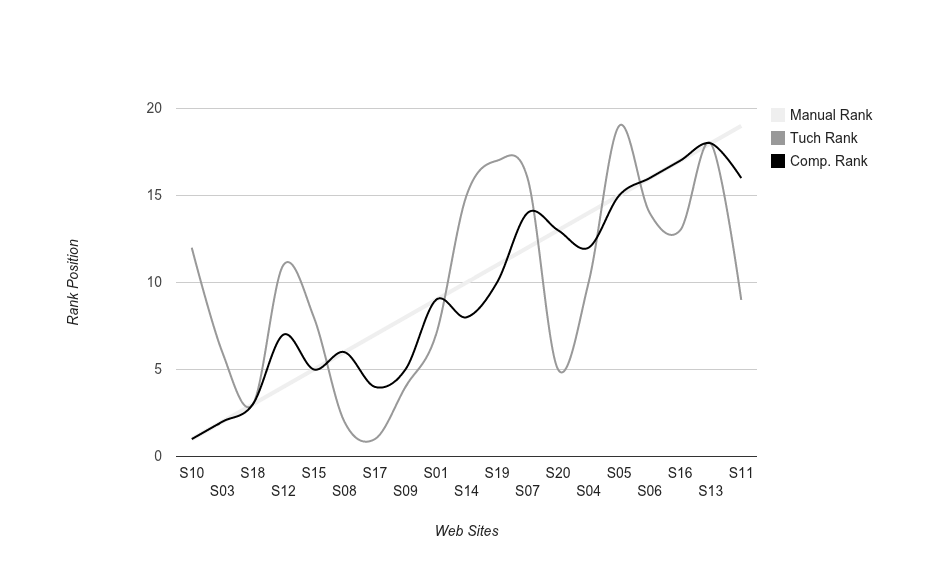
Ranking Scores from Manual and Computational Algorithm – Line
The perception of the visual complexity of World Wide Web (Web) pages is a topic of significant interest. Previous work has examined the relationship between complexity and various aspects of presentation, including font styles, colours and images, but automatically quantifying this dimension of a web page at the level of the document remains a challenge. In this paper we demonstrate that areas of high complexity can be identified by detecting areas, or ‘chunks’, of a web page high in block-level elements. We report a computational algorithm that captures this metric and places web pages in a sequence that shows an 86% correlation with the sequences generated through user judgements of complexity. The work shows that structural aspects of a web page influence how complex a user perceives it to be, and presents a straightforward means of determining complexity through examining the DOM.
Reference
 Harper, S., Jay, C., Michailidou, E., & Quan, H. (2012). Analysing the visual complexity of web pages using document structure Behaviour & Information Technology, 1-12 DOI: 10.1080/0144929X.2012.726647
Bibtex
@article{doi:10.1080/0144929X.2012.726647,
 author = {Harper, Simon and Jay, Caroline and Michailidou, Eleni and Quan, Huangmao},
 title = {Analysing the visual complexity of web pages using document structure},
 journal = {Behaviour & Information Technology},
 volume = {0},
 number = {0},
 pages = {1-12},
 year = {0},
 doi = {10.1080/0144929X.2012.726647},
 URL = {http://www.tandfonline.com/doi/abs/10.1080/0144929X.2012.726647},
 eprint = {http://www.tandfonline.com/doi/pdf/10.1080/0144929X.2012.726647},
 abstract = { The perception of the visual complexity of World Wide Web (Web) pages is a topic of significant interest. Previous work has examined the relationship between complexity and various aspects of presentation, including font styles, colours and images, but automatically quantifying this dimension of a web page at the level of the document remains a challenge. In this paper we demonstrate that areas of high complexity can be identified by detecting areas, or ‘chunks’, of a web page high in block-level elements. We report a computational algorithm that captures this metric and places web pages in a sequence that shows an 86% correlation with the sequences generated through user judgements of complexity. The work shows that structural aspects of a web page influence how complex a user perceives it to be, and presents a straightforward means of determining complexity through examining the DOM. }
 };
 Bugs Become Features...